
A Spotlight on Censorship
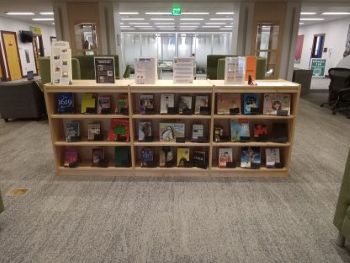
From March 27th to April 10th, a display titled “A Spotlight on Censorship” can be found in the central bookcase on the first floor of Lucy Scribner Library. This display was put together by Elizabeth Pyle ‘28 as part of an Honor’s Forum Civic Life project. Inspired by a final project in SW 212: Power, Privilege, and Oppression, taught by Professor June Paul, this display is intended to highlight the disproportionate impact of book bans on already marginalized communities, as well as showcase the underlying reasons why books are often banned. Such a display is particularly relevant, right now, as book banning has become a frighteningly common part of American culture in recent years. The American Library Association has reported that the number of titles challenged in 2024 (2,542) has far exceeded the average number of unique titles challenged annually between 2000 and 2020 (273).
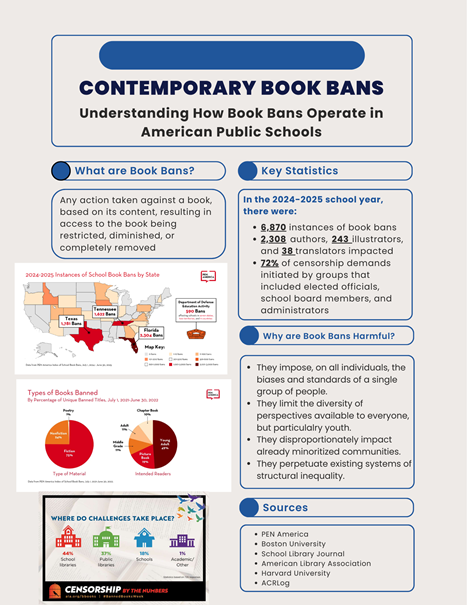
This drastic rise in book bans is concerning because it is a clear violation of individuals’ First Amendment rights. Such a topic has been hotly debated at a national level since 1982 (though the debate itself extends back much further), when the Supreme Court ruled on the case Island Trees School District v. Pico. After a parent complaint led to nine books being removed from the libraries of a New York school district, senior Steven Pico joined with four other students to challenge the decision of his school board. Pico’s case eventually made it to the Supreme Court, which ruled that the school board’s decision was in violation of the Constitution’s First Amendment. In their ruling, the Supreme Court also argued that “…bans may not suppress ideas or authors based on political, partisan, or opinion-based reasoning.” Despite taking place over forty years ago, Island Trees School District v. Pico remains a landmark Supreme Court case in the fight against book bans. Today, it continues to set the precedent that book banning in schools is unconstitutional and, thus, something against which one must speak out.
Perhaps even more concerning is the fact that book bans pose a clear social justice issue, as they have a disproportionate impact on already marginalized communities. The books that are most frequently challenged in schools are the ones that confront societal norms or provide a voice to groups of people that have historically been disempowered. As a result, book bans disproportionately target works by and about women, people of color, and those who are part of the LGBTQIA+ community. Such trends have led to authors of color being 4.5 times more likely to be banned than white authors (Goncalves et al.). Furthermore, in the 2021-2022 school year, 41% of books banned in schools had LGBTQIA+ characters, and 40% had characters that were people of color (Pen America). Thus, such book bans not only lead to a loss of diverse reading material, but they also erase the experiences of marginalized groups and perpetuate harmful prejudices at a systemic level.
The goal of this display is to generate awareness about such a disproportionate impact. While it is set up, students, staff, and community members will be able to interact with the display in a variety of ways. They may read the provided infographics, in order to learn more about book bans. Or they may check out one of the books in the display, an active method of resisting book bans. Additionally, in front of each book is a card stating the “official” reason that is often given for banning or challenging each book. Written in invisible ink on each card is the real, unspoken reason why each book is banned. Display visitors can use the provided blacklight flashlights to explore the discrepancy between what is typically said about book bans and what is truly intended. Finally, if visitors feel inspired to act against such an important issue, they can make use of numerous provided resources to do so.
Regardless of what type of action is most feasible for an individual, staying silent is not an option. Book banning is clearly a social justice issue; thus, we, as members of society, have an obligation to protect everyone’s freedom to share ideas. As long as books are continuing to be banned, our ability to think critically, challenge biases, and understand the world around us is intensely threatened.
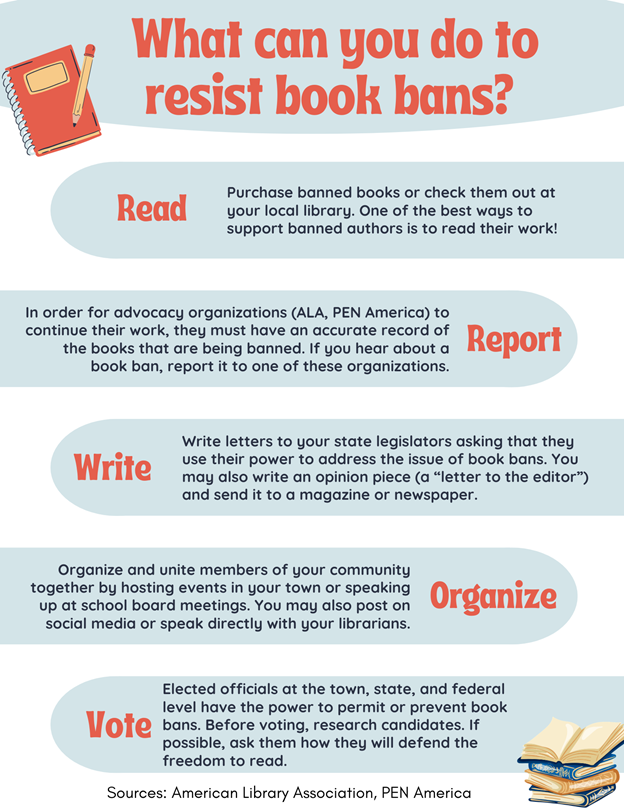
If you would like to take action against book banning at the national or local level, check out a few of the following resources:
- American Library Association Office of Intellectual Freedom: https://www.ala.org/aboutala/offices/oif
- Unite Against Book Bans: https://uniteagainstbookbans.org/take-action/
- The Freedom to Read Foundation: https://www.ftrf.org/
- Digital Public Library of America’s Banned Books Club: https://action.everylibrary.org/
- National Coalition Against Censorship: https://ncac.org/
Additional Sources Used: Goncalves et al., 2024, National Women’s Law Center, American Psychological Association, PEN America, Emory University, Bill of Rights Institute, National Coalition Against Censorship, Alchetron Encyclopedia, New York Times